BS 5837:2012 Surveys for Trees in Relation to Construction
Helping your project and your trees reach the same outcome
BS 5837:2012 is the British Standard that sets out how trees should be considered and protected in relation to design, demolition, and construction works. Where trees are present on or near a development site, most planning authorities will require a BS 5837 survey before granting permission. Getting this right early is one of the most effective ways of keeping a project on track.
The most common and costly mistake on construction projects involving trees is bringing the arboricultural consultant in too late. Trees considered at the design stage become a manageable constraint. Trees considered after planning submission become an obstacle. At Hebden Arboriculture the aim is to be a working part of the design team from the outset, understanding what the project genuinely needs to succeed and finding solutions that work for both the development and the trees on site.
A full BS 5837 survey comprises the following:
1. An initial site survey categorises each tree by quality and remaining contribution, giving the Local Planning Authority a clear picture of what is present.
2. An Arboricultural Impact Assessment examines how the proposed works will affect those trees, and what constraints they place on the design.
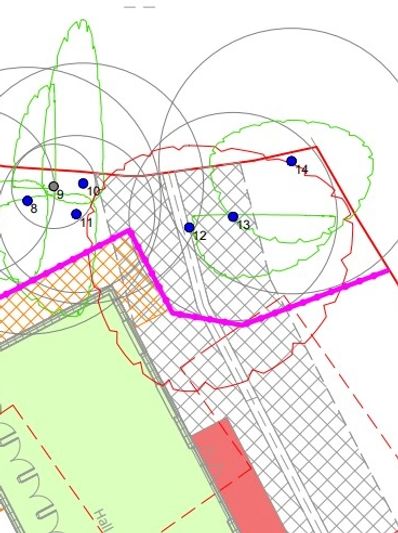
3. These constraints are mapped onto a Tree Constraints Plan, which shows crown spreads and Root Protection Areas.
4. A Tree Protection Plan sets out the physical measures required to protect retained trees during construction.
5. All of this is supported by an Arboricultural Method Statement, which gives contractors the practical guidance they need to carry out works without damaging the retained trees.
BS 5837 surveys are provided across Somerset, North Somerset, Bristol, and South Wales, including for large-scale commercial and infrastructure projects.